


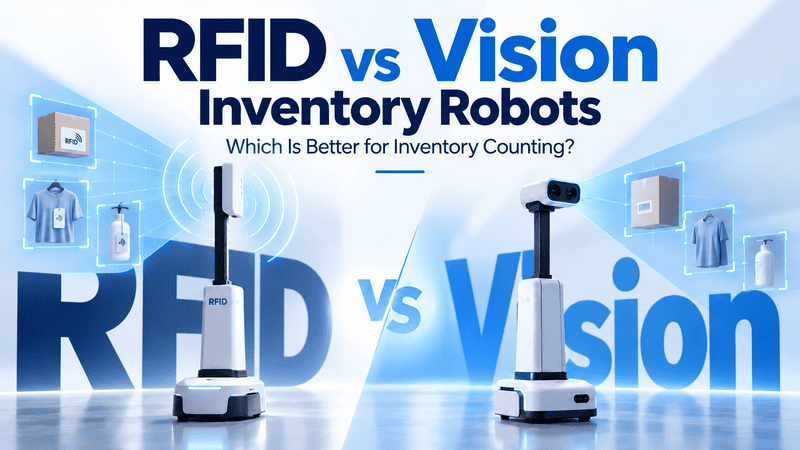
As retailers and warehouse operators place greater emphasis on inventory accuracy and counting efficiency, RFID inventory robots and vision inventory robots are becoming two common automation options. Both can reduce manual inventory counts, but they collect inventory data in very different ways.
RFID primarily identifies inventory by reading item tags, while vision robots use cameras and computer vision to analyze products and shelf conditions. So which is better for inventory counting: RFID or vision inventory robots? Below, we compare them across inventory-counting accuracy, RFID tag requirements, line of sight and occlusion, cost, and use cases.
RFID vs. Vision Inventory Robots: Quick Comparison for Inventory Counting
| Facteur de comparaison | RFID Inventory Robots | Vision Inventory Robots |
|---|---|---|
| Primary identification method | Reads RFID tags | Cameras + computer vision / AI |
| Does each item need an RFID tag? | Oui | Usually no |
| Does it need to “see” the product? | No direct line of sight required | Usually needs a visible product or shelf cue |
| Item-level identity recognition | Strong, provided the tags are correct and readable | Depends on product visibility and the recognition approach |
| Occluded / stacked products | Usually has an advantage | More affected by occlusion |
| Out-of-stocks, misplacements, pricing, and merchandising checks | Limited when used alone | Usually has an advantage |
| Best suited core need | Know “exactly which item is present or missing” | Know “what is happening on the shelf right now” |
In simple terms: RFID is like reading an item’s “digital ID,” with the goal of confirming whether a specific item is present. A vision robot is more like inspecting the shelf: in addition to identifying products, it can detect out-of-stocks, misplaced items, price-label issues, and merchandising problems.
How Do RFID Inventory Robots and Vision Inventory Robots Perform Inventory Counts?
RFID Inventory Robots
RFID inventory robots typically combine a mobile robot, an RFID reader, and antennas. As the robot moves along shelves or warehouse aisles, it automatically reads RFID tags on products and matches the tag data with item records in the inventory system.
Their biggest advantage is that they do not need to directly “see” the product. Even when items are covered, stacked, or inside cartons, the robot may still identify the inventory as long as the RFID tags can be read successfully.
However, RFID does not achieve a perfect read rate in every environment. Tag placement, antenna orientation, metal, liquids, and the local RF environment can all affect read performance. That is why, when evaluating an RFID robot, it is more important to test how well it reads your actual products in your real shelf or warehouse environment.
Vision Inventory Robots
Vision inventory robots primarily use cameras to capture shelf images, then apply computer vision and AI to identify products and shelf conditions.
In addition to determining whether a product is on the shelf, they can detect out-of-stocks, low stock, misplaced products, price-label errors, and merchandising issues. In other words, vision robots look not only at “how many products are there,” but also at “what is happening on the shelf right now.”
Their limitations are also clear: occluded products, reflective packaging, changing lighting, or SKUs with very similar appearances can all make recognition more difficult. As a result, the core value of a vision robot is often not just inventory counting, but turning shelf data into actionable tasks such as replenishment, correction, and merchandising optimization.
Bottom line: RFID is better at identifying “what the item is and whether it is present,” while vision is better at understanding “what is happening on the shelf.” Once you understand this difference, the specific tradeoffs between the two types of inventory robots become much easier to evaluate.
RFID vs. Vision Inventory Robots: 5 Key Differences for Inventory Counting
1. Inventory Counting Accuracy: Which Is More Accurate, RFID or Vision?
When comparing RFID and vision inventory robots, you cannot rely on a single “accuracy” number because the two technologies are not always measuring the same thing.
- If the goal is to identify every RFID-tagged item, RFID usually has an advantage.
- If the goal is to determine whether a shelf is out of stock, contains misplaced items, or has merchandising issues, vision usually has an advantage.
- If the goal is to identify issues that genuinely require employee action, you also need to consider alert accuracy and whether the system can turn alerts into completed tasks.
So instead of asking, “Which one is more accurate?” first define what you need the system to identify accurately.
2. Line of Sight: Do RFID and Vision Need to See the Product?
RFID does not require the reader to directly “see” the tag, so it generally has an advantage when products are covered, folded, stacked, or inside packaging.
Vision robots need a sufficiently clear view of the product or shelf, which makes them more sensitive to occlusion, lighting conditions, and how products are arranged.
In simple terms, if you want to know “how many tagged items are here,” RFID’s non-line-of-sight reading is more valuable. If you want to know “can a customer actually find the product on the shelf right now,” vision provides a view that is closer to the real shelf condition.
3. RFID Tag Requirements: Does Every Item Need an RFID Tag?
RFID inventory counting depends on the target items having readable RFID tags.
If a company already has an item-level RFID program, the robot can use existing tags for automated inventory counts. If RFID is not yet in place, additional considerations include RFID tags and encoding, tagging workflows, supplier coordination, tag quality management, and system integration.
Vision inventory robots usually do not require an additional RFID tag on every item. For companies that have not deployed item-level RFID, this can mean fewer upfront process changes.
4. Inventory Counting vs. Shelf Intelligence: Counting Inventory or Understanding the Shelf?
This is one of the most fundamental differences between the two technologies. RFID is better at providing visibility into item identity and inventory presence, while vision is better at understanding the physical condition of products on the shelf.
| RFID Is Better Suited to Answer | Vision Is Better Suited to Answer |
|---|---|
| Is this tagged item on site? | Is this shelf location out of stock? |
| Which specific items were read here? | Is the product in the wrong location? |
| How many tagged units of this product are here? | Is the price label incorrect? |
| Was this specific item read? | Does the actual display match requirements? |
For example, a system may show that an item is “in stock,” even though it is still in the backroom or sitting in the wrong shelf location. For a store, simply knowing that a product is “in the store” is not enough. It also matters whether customers can find it on the correct shelf.
5. RFID vs. Vision Inventory Robot Cost: How Do Costs and TCO Compare?
When purchasing an inventory robot, you should not compare hardware prices alone. It is more important to look at coût total de possession (TCO).
| Common RFID Solution Cost Items | Common Vision Solution Cost Items |
|---|---|
| Robot, RFID reader, and antennas | Robot, cameras, and other sensors |
| RFID tags and encoding | Computer vision / AI software and compute |
| Tagging workflows and supplier coordination | Model maintenance and product data maintenance |
| Intégration système | Intégration système |
| Operations, maintenance, and support | Operations, maintenance, and support |
If a company already has an RFID tagging program, the incremental cost structure of an RFID robot can be very attractive. If the business needs to start from scratch and add item-level tags to a large number of products, the cost model changes completely. Vision solutions avoid item-level RFID tags, but they are not “zero cost” either; recognition models, data processing, SKU changes, and system integration still need to be considered.
RFID vs. Computer Vision Inventory Robots: Which Is Better for Different Inventory Use Cases?
| Typical Scenario | Usually a Better Fit | Pourquoi ? |
|---|---|---|
| Apparel and footwear | RFID or hybrid | Many SKUs, size and color variants, products often overlap, and item-level identification is valuable |
| Supermarkets and grocery retail | Vision | Greater focus on out-of-stocks, low stock, misplacements, price labels, and shelf or merchandising conditions |
| Warehouses or backrooms already using RFID extensively | RFID | Can leverage existing RFID tags for more frequent automated inventory counts |
| General merchandise, pharmacies, and electronics | Vision or hybrid | Depends on whether RFID is already in place and whether both inventory and shelf data are needed |
| Need both item-level identity and shelf context | RFID + vision | The two data types complement each other and can distinguish between “the product is in the store” and “the product is correctly stocked on the shelf.” |
RFID or Vision Robot for Inventory Counting: Which Inventory Robot Is Right for You?
- Are your products already tagged with item-level RFID? If the answer is “yes,” the barrier to deploying RFID is significantly lower.
- What do you most need to know: “exactly which items are here,” or “is the shelf out of stock, are items misplaced, or is the price label wrong?” The first points toward RFID; the second points toward vision.
- Are products frequently covered, stacked, folded, or packed in cartons? If so, RFID’s non-line-of-sight reading is usually more valuable.
- Beyond inventory counting, does each scan also need to support pricing, planogram compliance, replenishment, and store execution? If so, vision can provide richer context.
RFID is better at understanding “item identity”; vision is better at understanding “shelf condition.” The best solution is the one that matches the inventory problem you need to solve, not simply the one with more sensors.
How to Validate RFID vs. Vision Inventory Robots in a Real-World Environment
This is also one of the most important steps for making a confident decision. Whether you choose RFID or vision, it is best to run a pilot with your own products, shelves, and workflows, and define the same acceptance metrics in advance.
- Inventory-count results: How much of the target inventory is actually identified or read? Where do most missed reads or detections occur?
- Alert quality: Of the out-of-stock, misplacement, or pricing issues flagged by the system, how many truly require employee action?
- Coverage: How much shelf space or inventory area can the robot cover in one scan? Which areas are frequently missed?
- Environmental stability: Do peak customer traffic, occlusion, reflections, metal, liquids, or packaging changes significantly affect results?
- Data latency: How long does it take from the robot scan to the point when an employee receives an actionable task?
- Integration and cost: How much work is required to connect with WMS, ERP, POS, planogram, or task-management systems? What is the cost per store or per successful inventory count?
If a vendor claims “99% accuracy,” do not look at that number alone. Ask three follow-up questions:
What exactly does the 99% measure? What is the denominator? How closely does the test environment match my real-world use case?
RFID and vision inventory robot test results are truly comparable only when they use the same measurement criteria and are tested in similar environments.
Conclusion
RFID is better at confirming “exactly which items are present,” especially in environments that already use item-level RFID or where products are frequently covered or stacked. Vision inventory robots are better at detecting out-of-stocks, misplacements, pricing issues, and merchandising problems, giving a view that is closer to the actual shelf condition.
If a company needs both accurate item-level inventory identification and shelf-condition data, a hybrid RFID + vision solution can often provide more value. The final choice should not be based only on a single accuracy figure or the hardware price. It should be based on whether the technology can consistently provide reliable, actionable inventory data in the real operating environment.
Want to find out which inventory counting solution is a better fit for your business?
Contact Fdata to evaluate the right inventory robot solution based on your product types, shelf environment, existing RFID infrastructure, and inventory counting requirements.
FAQ
Is RFID Inventory Counting More Accurate Than Vision Inventory Robots?
Not necessarily. RFID inventory robots are better suited to item-level identification and inventory counting, while vision inventory robots are better suited to detecting out-of-stocks, misplacements, pricing issues, and merchandising problems. Actual accuracy depends on the products and the store environment.
Does a Vision Inventory Robot Require RFID Tags?
Usually not. Vision inventory robots primarily use computer vision, AI, OCR, and barcode recognition to identify products and shelf conditions. RFID can be used as a complementary technology.
Can a Vision Inventory Robot Replace RFID?
Not completely. Vision inventory robots are well suited to shelf monitoring and out-of-stock detection. RFID has an advantage when products are covered or stacked, or when unique item-level identification is required.
Which Is Better for Multiple Stores: RFID or Vision Inventory Robots?
It depends on the existing infrastructure. Companies with a standardized RFID tagging program can deploy RFID more easily, while vision solutions need to account for differences in shelf layouts, lighting, and SKU data across stores.
Do You Still Need Manual Inventory Counts After Deploying an Inventory Counting Robot?
Usually yes, but the amount of manual counting can be reduced. An inventory counting robot can automatically scan inventory and identify exceptions, while employees mainly handle inventory discrepancies, misplaced items, and products the system cannot identify.
Can an Inventory Counting Robot Connect to WMS, ERP, and POS Systems?
Usually yes. When selecting an inventory counting robot, confirm that it supports APIs and can integrate with WMS, ERP, POS, and product databases so inventory data can be synchronized automatically.
