


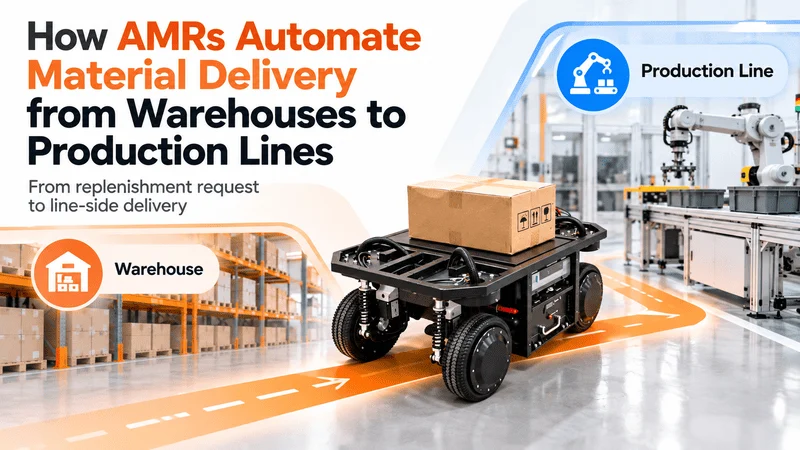
Imagine an assembly line in full production. There is only one box of screws left at a workstation. The warehouse has plenty in stock, but if nobody notices the shortage, requests more parts, prepares the order, and delivers it in time, the line could still stop while waiting for materials.
Autonomous mobile robots (AMRs) can help factories handle this repetitive material transport. They can travel independently between warehouses and production lines, but true automated delivery involves much more than simply moving goods from one place to another.
Let’s walk through a straightforward example to see how this process works.
1. How Do AMRs Deliver Materials from a Warehouse to a Production Line? The 7-Step Process
Suppose Assembly Line A needs two boxes of screws. The warehouse has the parts in stock, and designated AMR pickup and drop-off stations are already in place. Here is what a typical delivery could look like. This is an illustrative example, not an actual customer project.
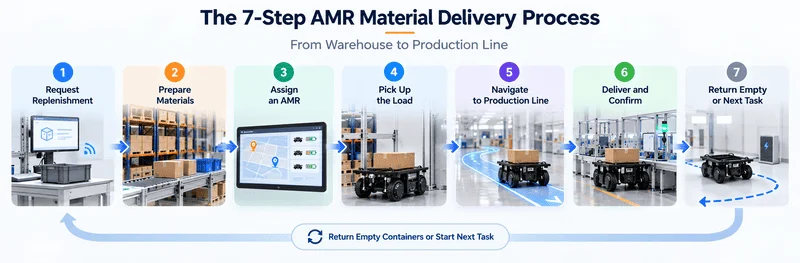
Step 1: The Production Line Requests Replenishment
When a workstation starts running low on parts, an employee can press a replenishment button. Alternatively, a digital kanban system, production management software, or an inventory-level trigger can generate the request automatically.
The request should specify what material is needed, how much is required, where it should be delivered, and when it is needed. For example: “Deliver two boxes of screws to Workstation 2 on Assembly Line A.”
Some factories also use scheduled material deliveries at regular intervals. The best approach depends on how consistent the production cycle is.
Step 2: The Warehouse Checks Stock and Prepares the Materials
After receiving the request, the warehouse system or staff checks availability and moves the correct materials to a designated pickup point. In a manually operated warehouse, an employee may scan the items or mark the order as ready. In an automated warehouse, a conveyor can transfer the boxes to a handover station.
An AMR arriving at the pickup point does not mean the load is ready. Without a clear “materials ready” confirmation, the robot could make an unnecessary trip or occupy the pickup area while waiting.
Step 3: The Fleet Management System Assigns an AMR
In factories operating multiple robots, a fleet management system typically coordinates delivery tasks. It checks which AMRs are available, their distance from the warehouse, their battery levels, and whether they can carry the requested load.
If several production lines need materials at the same time, the system also sets task priorities and coordinates robot movements to prevent congestion in narrow aisles.
Think of the fleet management system as a dispatcher and the AMRs as the delivery vehicles carrying out its assignments.
Step 4: The AMR Travels to the Warehouse and Picks Up the Load
Once assigned, the AMR follows its factory map to the pickup station and positions itself at the designated location. How the materials are loaded depends on the robot design and the equipment installed at the pickup point.
For example, a lift-type AMR can raise a compatible material rack, a conveyor-top AMR can transfer boxes to or from a matching conveyor, and a tugger AMR can pull a material cart. If the site does not have automated loading equipment, staff may still need to load the materials manually.
In other words, autonomous navigation and automatic loading are two different capabilities.
Step 5: The AMR Navigates to the Production Line
After the load is confirmed, the AMR travels toward Assembly Line A. It may use LiDAR, cameras, and other sensors to detect its surroundings while referring to a previously created map to determine its position.
If a person or forklift blocks its route, the robot typically slows down or stops according to its safety settings. Some systems can select an alternative route when the map, available space, and traffic rules allow it. This does not mean an AMR can drive around every obstacle in every environment.
For a factory, safe, consistent, on-time delivery matters more than a robot’s maximum advertised speed.
Step 6: The Production Line Receives and Confirms the Delivery
When the AMR reaches Workstation 2 on Assembly Line A, it first needs to confirm that the drop-off position is available. The boxes or rack can then be unloaded.
For an automated handover, the robot and line-side equipment typically exchange signals such as “permission to unload” and “unloading complete.” If an operator receives the materials manually, they may scan the load or confirm receipt in the system.
One important detail is easy to overlook: “AMR arrived” is not the same as “correct materials received.” A complete delivery process should verify the handover and record its outcome.
Step 7: The AMR Returns Empty Containers or Starts Its Next Task
After the delivery, the AMR can return to the warehouse, serve another workstation, or head to a charging station if its battery is low. If the production line has empty containers to return, the workflow can also be designed to deliver full boxes and collect empties on the return trip.
That completes one end-to-end material delivery cycle from the warehouse to the production line.
The 7-step AMR delivery workflow at a glance:
Replenishment request → Warehouse preparation → AMR assignment → Pickup → Autonomous transport → Delivery confirmation → Empty-container return or next task.
2. How Does an AMR Know When to Deliver Materials, and Who Controls the Process?
You may be wondering whether a robot can tell by itself which production line is running out of parts. Usually, it cannot. The AMR carries out the transport task; replenishment rules and connected systems determine what to deliver and when.
Three Common Ways to Trigger Material Replenishment
1. Scheduled delivery
Materials arrive at fixed intervals, which can work well for production lines with steady consumption.
2. On-demand replenishment
A worker presses a button or a digital kanban system sends a request, making it useful when orders and material consumption change frequently.
3. Inventory-triggered replenishment
A delivery request is created when stock at a workstation falls to a preset level, leaving time for preparation and transport.
WMS, MES, and Fleet Management Explained Simply
You do not need to memorize every software acronym to understand how automated warehouse-to-production-line delivery works. Each system has a different job:
| System or Equipment | In Plain English | Role in Material Delivery |
|---|---|---|
| MES (Manufacturing Execution System) | Tracks what the production line needs to do. | Provides production requirements or workstation replenishment signals. |
| WMS (Warehouse Management System) | Tracks what is in the warehouse and where it is stored. | Checks inventory, supports order preparation, and updates relevant stock information. |
| AMR Fleet Management System | Dispatches robots and coordinates their movements. | Assigns tasks to suitable AMRs and manages delivery order and robot traffic. |
| AMRs and On-Site Equipment | Perform the physical work. | Handle pickup, transport, docking, unloading, and status feedback. |
Not every factory needs to deploy all these systems at once. In a smaller facility with a straightforward workflow, a button or equipment signal combined with AMR fleet software may be enough to start a delivery task.
Whatever the setup, the system needs to answer four basic questions: What should be delivered? Where should it be picked up? Where should it go? How will successful delivery be confirmed?
3. Can AMRs Automatically Load and Unload Materials?
This is one of the most important questions to clarify when planning automated material delivery between a warehouse and a production line. A robot’s ability to navigate autonomously does not necessarily mean loading and unloading can happen without people.
Three common material-handling methods are:
| Tipo AMR | Typical Loads | What the Site Needs |
|---|---|---|
| Lift-Type AMR | Material racks and compatible carriers | Compatible rack clearance, lifting interface, and placement position |
| Conveyor-Top AMR | Totes and reusable containers | Matching transfer heights and control signals at pickup and drop-off stations |
| Tugger AMR | Material carts and trailers | Compatible towing couplings, turning space, and parking positions |
Consider the same two boxes of screws. If they are packed in standardized totes, a conveyor-top AMR may be a practical option for automated transfer. If several boxes sit on a rack, a lift-type AMR may be more suitable. The final choice still depends on the load’s weight and dimensions, the available workstation space, and the on-site equipment.
To determine whether a workflow is truly end-to-end automated, check three points: Are the materials confirmed ready before pickup? Is loading confirmed after pickup? Is receipt confirmed after unloading? If one of these tasks still requires a person, that can be perfectly workable—the project should simply define its automation scope accurately.
4. What Happens If an AMR Encounters an Obstacle, Missing Materials, or a Breakdown?
In a real factory, forklifts cross aisles, delivery stations become occupied, and production plans change. A reliable AMR material delivery system must account for these situations—not just a journey where everything goes smoothly.
Situation 1: A Person or Forklift Blocks the Route
The AMR should slow down, stop and wait, or take an alternative route when conditions allow, following its configured safety strategy. Factories still need clear traffic rules for mixed pedestrian and vehicle areas, narrow aisles, and intersections.
Situation 2: The AMR Arrives, but the Production Line Cannot Receive the Load
The system should have the robot wait in a safe location until the drop-off station confirms it is available. This helps prevent the AMR from blocking a main aisle.
Situation 3: The Warehouse Has Not Prepared the Materials
The system should alert the warehouse and keep the task in a waiting state rather than repeatedly sending the robot on an unnecessary trip. Any material shortage should also be communicated promptly to the relevant production staff.
Situation 4: The AMR Has a Low Battery, Malfunctions, or Loses Communication
The system needs predefined rules for alerts, stopping, or reassigning tasks. Once operations resume, the location of the materials and the task status should be checked to avoid delivering the same load twice.
Safety must be part of the system design, not an optional feature. For applicable driverless industrial trucks and their systems, ISO 3691-4:2023 provides relevant safety requirements. Site-specific risk assessments and protective measures should be reviewed by qualified project personnel.
5. What Should a Factory Prepare Before Deploying an AMR Material Delivery System?
Before comparing AMR brands or prices, start by documenting your actual material delivery needs. These five considerations are often more important than looking only at a robot’s top speed and rated payload.
1. Identify the materials being transported
Record the part types, weight per load, dimensions, packaging, and carrier type. Consider the load’s center of gravity and whether it may tip over—not just its weight.
2. Measure how frequently deliveries are needed
Track more than the daily number of trips. Determine how many replenishment requests occur during the busiest hour and how long each workstation can wait for materials.
3. Walk the proposed route
Check narrow aisles, turning areas, floor slopes, forklift crossings, access doors, wireless coverage, and charging locations to assess whether the robot can operate safely.
4. Plan pickup and drop-off stations in advance
Can the warehouse prepare materials efficiently? Can the AMR align with the handover point? Is there enough room beside the production line to unload the materials? These details determine how practical automatic loading and unloading will be.
5. Pilot one route before expanding
Start with a repetitive route and relatively consistent materials. Test replenishment requests, loading, travel, unloading, empty-container returns, and exception handling before adding more robots or production lines.
How Can You Tell Whether an AMR Pilot Is Working?
Do not evaluate the pilot only by counting completed trips. More useful measures include:
- On-time delivery rate: The share of tasks in which the correct materials arrive within the agreed time.
- Replenishment lead time: How long it takes from the production line’s request to confirmed receipt.
- Material shortage impact: Whether delayed delivery still causes workstations to wait or production to stop.
- Manual intervention frequency: How often staff must step in to help the robot complete a task.
Compare results before deployment and during the pilot using consistent definitions. Factory layouts, production rates, and equipment vary, so avoid relying on unverified claims about a fixed percentage improvement in efficiency.
For help estimating robot quantities, read Fdata Robot’s AMR fleet sizing guide. If you are preparing the site, see the Guida passo passo all’implementazione degli AMR in un magazzino.
Conclusione
The value of AMR material delivery goes beyond replacing manual transport. It connects warehouse preparation, task assignment, material movement, and line-side receipt into a continuous, traceable workflow. With appropriate system coordination and automation equipment, factories can reduce repetitive handling and unnecessary waiting while keeping material supply more closely aligned with production needs.
Every factory has different materials, transport routes, and production requirements. Reliable automated delivery depends on selecting suitable AMR equipment and supporting systems for the actual payload, delivery frequency, available space, and pickup and drop-off methods.
Planning AMR Material Delivery from Your Warehouse to the Production Line?
Fdata Robot offre AMR mobile platforms, robot chassis, and custom hardware development services. Whether you need to transport totes, racks, or material carts, share your load specifications, transport routes, and automatic loading or unloading requirements with our team.
We can discuss an AMR hardware solution suited to your application and help you take the next step toward automated material delivery.
Domande frequenti
How Long Does It Take an AMR to Deliver Materials from a Warehouse to a Production Line?
.AMR delivery time depends on the travel distance, driving speed, loading and unloading time, and traffic conditions. The full replenishment cycle also includes warehouse preparation, task assignment, and confirmation of receipt at the production line.
Can One AMR Deliver Materials to Multiple Production Workstations?
Yes. If its payload capacity and available loading space allow, one AMR can deliver materials to multiple workstations in sequence. The fleet management system can coordinate the delivery order and track each handover.
Can AMRs Deliver Materials to Production Lines 24/7?
.Yes. With automatic charging, task scheduling, and coordinated operation of multiple robots, an AMR system can support round-the-clock material delivery. Individual robots still require charging and routine maintenance.
Do Existing Factories Need Magnetic Tape or Floor Modifications to Deploy AMRs?
.Magnetic tape is generally unnecessary for AMRs that use autonomous navigation technologies such as LiDAR SLAM. However, the floor condition, aisle width, and pickup and drop-off areas must still meet the robot’s operating requirements.
Can AMR Delivery Routes Be Changed When the Production Line Layout Changes?
.Yes. AMRs with autonomous navigation can typically adapt through map updates, revised delivery stations, and updated task settings. The revised routes and operating safety should be validated before use.
How Much Does an AMR Warehouse-to-Production-Line Delivery System Cost?
.AMR material delivery costs depend on the number of robots, payload requirements, loading and unloading equipment, fleet management software, and integration needs. A realistic budget should be based on delivery frequency, route conditions, and the required level of automation.
How Long Does It Take to Deploy an AMR Material Delivery System?
.The deployment timeline depends on site conditions, fleet size, system connections, and customization requirements. Simple point-to-point delivery projects are generally easier to implement than projects involving multiple production lines and automated loading equipment.
Which Factories Are Best Suited for AMR Warehouse-to-Line Material Delivery?
.Manufacturing facilities with frequent, repetitive material transport needs are good candidates for AMR delivery. It is especially worth evaluating when a factory needs flexible routes, less manual transport, and automated production line replenishment.
