


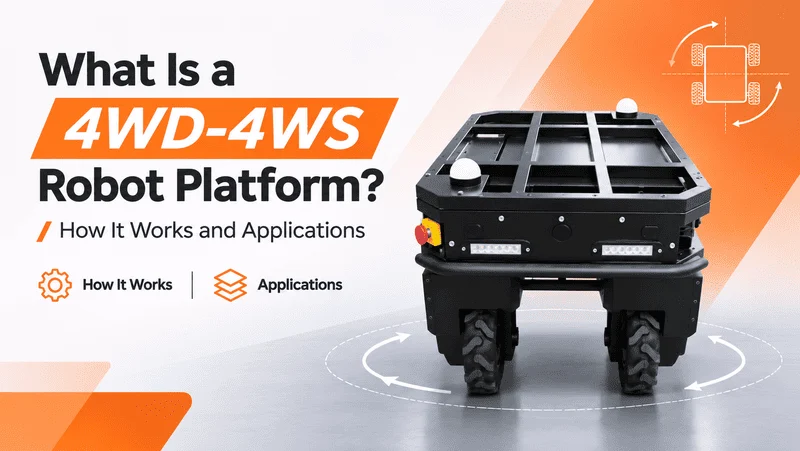
A 4WD-4WS (Four-Wheel Drive, Four-Wheel Steering) robot platform is a mobile robotic base that combines four-wheel drive with four-wheel steering. By coordinating the speed and steering angle of each wheel, it enables flexible turning and maneuvering. Depending on its mechanical design and control capabilities, it can also perform lateral movement, diagonal travel, and in-place rotation. These features make it suitable for industrial automation, warehouse logistics, and mobile robotics development.
But how exactly does a 4WD-4WS robot platform work? What advantages does it offer, and where is it most useful? This article explains its basic concepts, working principles, motion modes, and practical applications to help you better understand this technology.
What Is a 4WD-4WS Robot Platform?
A 4WD-4WS robot platform is a mobile robotic base that combines four-wheel drive and four-wheel steering technologies. The two terms refer to different functions:
- 4WD (Four-Wheel Drive): All four wheels provide driving force to move the robot.
- 4WS (Four-Wheel Steering): All four wheels participate in steering, allowing the robot to adjust its travel direction more flexibly.
In simple terms, four-wheel drive provides the power, while four-wheel steering controls the direction. Working together, these systems allow the robot to move forward, reverse, and turn. Depending on the chassis design and configuration, they may also support more advanced movements.
However, four-wheel steering is not necessarily the same as four-wheel independent steering. Some platforms use mechanically linked steering systems, where the front and rear wheels follow a fixed steering relationship. Others feature independent steering mechanisms that allow each wheel’s steering angle to be controlled separately, providing greater flexibility.
As a result, not every 4WD-4WS robot platform can move sideways or rotate in place. These capabilities depend on the steering mechanism, wheel steering range, and motion modes supported by the control system.
How Does a 4WD-4WS Robot Platform Work?
A 4WD-4WS robot platform operates through the coordinated control of its drive system, steering system, and control system. The drive system rotates the wheels, the steering system adjusts their direction, and the control system coordinates wheel speeds and steering angles to move the robot smoothly along the desired path.
1. Drive System: Controlling Wheel Speed
The drive system uses motors to rotate the wheels, providing the power needed for forward movement, reversing, and turning.
When the robot turns, different wheels may follow different paths, so their rotational speeds must be coordinated. On a platform with four-wheel independent drive, the control system can adjust the speed and rotation direction of each wheel separately, enabling more flexible movement.
2. Steering System: Controlling Wheel Direction
The steering system uses steering motors or other actuators to adjust the angle of each wheel and change the robot’s direction of travel.
Unlike conventional vehicles that primarily rely on front-wheel steering, a four-wheel steering robot platform uses both the front and rear wheels for directional control. Some models feature four-wheel independent steering, allowing each wheel’s angle to be controlled individually.
This provides the mechanical foundation for advanced movements such as diagonal travel, sideways movement, and in-place rotation.
3. Coordinated Control: Making All Four Wheels Work Together
The control system acts as the robot’s brain, coordinating driving and steering operations.
For example, when the robot needs to turn left, the controller calculates the required steering angle and speed for each wheel based on the desired movement. It then sends commands to the drive motors and steering actuators.
Feedback devices, such as wheel encoders and steering angle sensors, help the controller monitor the actual wheel positions and speeds, allowing it to adjust commands as needed.
This process involves robot kinematics, which converts the robot’s desired movement into individual wheel commands. For a platform with independently steerable wheel modules, the basic idea is straightforward: the controller determines which direction each wheel should point and how fast it should rotate, then coordinates all four wheels to produce the desired movement.
What Motion Modes Does a 4WD-4WS Robot Platform Support?
One of the main advantages of a 4WD-4WS robot platform is its flexible movement capabilities. By adjusting wheel steering angles and rotational speeds, the robot can perform basic movements such as straight-line travel and turning. With the appropriate mechanical design and control capabilities, it may also support crab steering, lateral movement, and zero-radius turning.
The following table explains four common motion modes and their practical benefits.
| Motion Mode | How It Works | Practical Benefits |
|---|---|---|
| Straight-Line Travel and Coordinated Steering | All four wheels coordinate their steering angles and rotational speeds based on the desired direction and turning path. | Enables smooth turning and helps the robot navigate through aisles or around obstacles. |
| Crab Steering and Diagonal Movement | All four wheels point in approximately the same diagonal direction, allowing the robot to travel diagonally while maintaining its body orientation. | Allows the robot to approach target positions or workstations at an angle without repeatedly changing its body orientation. |
| Lateral Movement | When the steering range and control system allow it, the wheels turn toward the sides of the chassis and work together to move the robot left or right. | Allows sideways position adjustments without rotating the robot’s body, making it useful for narrow spaces and workstation docking. |
| Zero-Radius Turning | The wheels roll along tangential paths around a common rotation center, allowing the robot to rotate around a point near its center. | Changes the robot’s orientation while keeping its center nearly stationary, reducing the travel distance needed to turn around. |
Not all 4WD-4WS robot platforms support every motion mode listed above. Actual capabilities depend on the steering mechanism, available steering angles, and control system configuration.
For example, crab steering generally refers to diagonal movement while maintaining the robot’s body orientation. It is not the same as purely sideways movement.
It is also important to understand that zero-radius turning does not mean the robot requires no turning space. Although the center of the chassis may remain nearly stationary, the corners of the robot and any mounted equipment, cargo, sensors, or robotic arms still sweep through an area as the robot rotates.
Therefore, sufficient clearance must be provided based on the robot’s overall dimensions and payload.
What Are the Advantages and Limitations of a 4WD-4WS Robot Platform?
The main advantages of a 4WD-4WS robot platform are flexible maneuverability and multiple steering options. These features are especially valuable for robots that frequently change direction or operate in confined spaces. However, the technology also has certain limitations.
Main advantages:
By coordinating the drive and steering of all four wheels, the robot can make flexible turns and, when supported, move sideways, travel diagonally, or rotate in place. This can reduce unnecessary repositioning and improve maneuverability in narrow aisles, warehouses, and industrial workstations.
Main limitations:
Compared with a simple differential-drive chassis, a 4WD-4WS system generally has a more complex mechanical structure and requires more precise control, calibration, and maintenance. Its performance also depends on factors such as floor conditions, tire characteristics, and payload, so it may not be the best solution for every application.
Comparison with other robot platforms:
Differential-drive robots primarily turn by creating a speed difference between the left and right wheels, offering a relatively simple structure. Mecanum-wheel robots use specially designed rollers to achieve omnidirectional movement.
A 4WD-4WS robot platform, by contrast, achieves flexible maneuvering by coordinating wheel directions and speeds. The best choice depends on the required movements, operating environment, payload, and budget.
What Are the Practical Applications of a 4WD-4WS Robot Platform?
Thanks to its flexible driving and steering capabilities, a 4WD-4WS mobile robot platform can be used in industrial automation, warehouse logistics, inspection robotics, and mobile robot development. It is particularly useful in applications that require frequent directional adjustments or precise positioning.
1. Industrial Automation and Warehouse Logistics
In factories and warehouses, material-handling robots frequently travel between storage racks, production lines, and assembly stations.
A 4WD-4WS mobile robot platform that supports lateral movement can adjust its position without changing the robot’s body orientation. This reduces the need for repeated turning maneuvers and makes material handling and workstation docking more flexible.
2. Industrial Inspection and Mobility in Complex Environments
Inspection robots often need to navigate equipment-dense industrial facilities, narrow passages, or environments that combine indoor and outdoor areas.
Four-wheel steering helps the robot adjust its travel direction, while four-wheel drive can provide traction under different ground conditions. These capabilities make the platform suitable for tasks such as equipment inspection and environmental monitoring.
However, actual terrain performance still depends on the tires, chassis structure, and ground conditions.
3. Mobile Manipulators and Robotics Development
Robots equipped with robotic arms, cameras, or other devices often need to adjust their position while maintaining a specific working orientation.
A 4WD-4WS mobile robot platform with lateral movement capability can support these requirements, making it a flexible foundation for mobile manipulation, intelligent service robots, and robotics research and development.
Models that provide development interfaces such as ROS, CAN, or SDKs can also make system integration and secondary development easier for engineers.
How to Determine Whether a 4WD-4WS Robot Platform Is Right for Your Project
When selecting a 4WD-4WS robot platform, maneuverability is only one factor to consider. It is equally important to evaluate the actual requirements of your application.
The following five factors can help you determine whether a platform is suitable for your project.
| Key Factor | What to Check |
|---|---|
| Motion Modes | Does the platform support lateral movement, diagonal travel, and in-place rotation? Are these standard features or optional configurations? |
| Payload and Ground Conditions | Do the maximum payload capacity, gradeability, and terrain capabilities meet your operating requirements? |
| Dimensions and Space Requirements | Are the chassis dimensions and required turning clearance suitable for your facility’s aisles and work areas? |
| Control and Development Interfaces | Does the platform offer CAN, SDK, ROS, or other interfaces and development support needed for system integration? |
| Navigation and Safety Features | Does the platform include autonomous navigation, obstacle avoidance, or emergency stop functions? Which features require additional integration? |
Fdata 4WD-4WS Robot Platform Examples
Different 4WD-4WS robot platform models may vary in payload capacity, supported motion modes, and operating environments.
For example, the Fdata A012 Plus mobile robot platform features four-wheel drive and four-wheel steering, with lateral movement available as an optional feature. It is suitable for applications such as logistics transportation, inspection, and robotics development.
The Fdata A026 Heavy-Duty 4WD-4WS Robot Chassis supports longitudinal and lateral movement and offers a maximum payload capacity of up to 1,000 kg, making it suitable for industrial material handling and heavy-duty automation projects.
Ultimately, choosing the right 4WD-4WS robot platform means matching its motion capabilities, payload performance, and control functions to your application’s actual needs. Before purchasing, it is advisable to confirm the specific configuration with the manufacturer and test the platform under real operating conditions.
Conclusion
A 4WD-4WS robot platform achieves flexible motion control by coordinating wheel speeds and steering angles. With the appropriate mechanical structure and control capabilities, it can perform lateral movement, diagonal travel, and in-place rotation, making it particularly useful for industrial automation, warehouse logistics, and mobile manipulator applications.
However, not every project requires a four-wheel drive, four-wheel steering platform. The right choice depends on your motion requirements, payload capacity, operating environment, and control interfaces. Evaluating these factors will help ensure that the platform meets the needs of your application.
Looking for the Right 4WD-4WS Robot Platform for Your Project?
Whether you need a standard 4WD-4WS robot platform or a customized solution for specific payload, size, or motion requirements, Fdata can help you select the right platform and provide technical support for your project.
Contact Fdata for Robot Platform Selection and Technical Advice →
FAQ
Can a 4WD-4WS Robot Platform Support Autonomous Navigation?
Yes, a 4WD-4WS robot platform can be used as the mobile base for an autonomous robot, but four-wheel drive and four-wheel steering alone do not provide autonomous navigation. To enable autonomous operation, the system typically needs additional sensors, such as LiDAR, cameras, and an inertial measurement unit (IMU), along with localization, path planning, and obstacle avoidance capabilities.
For AGV or AMR projects, it is important to confirm whether the platform provides navigation interfaces and whether autonomous navigation functions require additional hardware or software development.
Is a 4WD-4WS Robot Platform Suitable for Outdoor Use and Uneven Terrain?
A 4WD-4WS robot platform can be used in certain outdoor environments, but not all models are designed for rough terrain. Actual mobility depends on factors such as tire type, ground clearance, drive torque, suspension design, and water and dust protection ratings.
If the robot needs to operate on slopes, gravel, or uneven surfaces, it is important to evaluate its gradeability under load, obstacle-crossing capability, and environmental protection. Testing under actual operating conditions is also recommended.
What Is the Difference Between 4WD-4WS, Differential Drive, and Mecanum Wheel Robot Platforms?
Differential-drive robot platforms turn by varying the speeds of the left and right wheels and generally cannot move directly sideways. Mecanum-wheel platforms use angled rollers and coordinated wheel speeds to achieve omnidirectional movement, including lateral motion. A 4WD-4WS robot platform uses controlled wheel steering angles and drive speeds to perform different types of movement.
There is no single best option for every application. The most suitable platform depends on floor conditions, payload requirements, available space, and maintenance needs.
What Is the Difference Between a 4WD-4WS Robot Platform and a Standard 4WD Robot Platform?
The main difference between a 4WD-4WS robot platform and a standard four-wheel drive platform is the steering system. Four-wheel drive means all four wheels provide driving force, but it does not necessarily mean all four wheels can steer.
A 4WD-4WS platform combines four-wheel drive with four-wheel steering, allowing the front and rear wheels to work together to reduce the turning radius. For robots that frequently change direction or operate in confined spaces, four-wheel steering can provide greater maneuverability and more motion control options.
How Do You Calculate the Minimum Aisle Width for a 4WD-4WS Robot Platform?
To determine the minimum aisle width required for a 4WD-4WS robot platform, you need to consider more than the chassis width. Other important factors include the wheel envelope during steering, the movement paths of the robot body and payload, and the necessary safety clearance.
For robots that need to rotate or dock sideways within narrow aisles, the swept area of the entire robot should be calculated or simulated based on the intended motion modes. On-site testing is recommended to verify that the robot can operate safely within the available space.
