


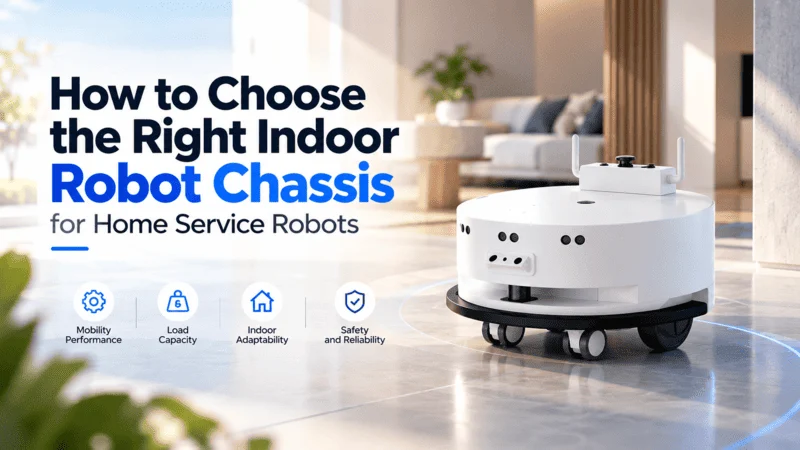
Choosing a home service robot chassis starts with the real tasks the robot must perform in a house. A mobile robot base for home delivery, indoor patrol, companionship, or an assistant with a robotic arm needs to move reliably through doorways, around furniture, and across common flooring. The chassis influences not only mobility, but also the finished robot’s footprint, stability, noise, and day-to-day usability.
This home service robot chassis selection guide covers seven practical decisions for robotics developers, OEMs, and product teams, from defining household requirements to testing an indoor robot chassis before purchase.
1. Define Your Home Service Robot Chassis Requirements
Before comparing home robot chassis models, define the application, operating conditions, and essential functions. This gives the engineering team a clear basis for rejecting unsuitable platforms early.
1.1 Match the chassis to the home robot application
A home delivery robot, a companion robot, and a mobile household assistant may use similar wheeled platforms, but they do not require the same chassis characteristics.
| Anwendung | Key chassis requirements | What is easy to overlook |
|---|---|---|
| Home delivery / item transport robot | Payload capacity, smooth starts and stops, access through narrow passages | Load-induced changes in the center of gravity; turning clearance near doors and furniture |
| Home patrol and companion robot | Precise low-speed control, battery runtime, quiet operation | Extended operating periods; people and pets crossing the robot’s route |
| Home assistant with a robotic arm | Load distribution, platform stability, mounting space | Tipping risk when the arm extends; power requirements of the upper structure |
A camera-equipped companion or patrol robot may need relatively little payload capacity. A mobile household assistant with an arm must also account for reach, upper-body mass, and changing load distribution. Comparing mobile robot chassis and platforms can help you identify a suitable starting point before committing to a custom upper structure.
1.2 Record doorways, furniture clearance, and household floors
Measure the narrowest clear doorway and hallway, turning space between furniture, door thresholds, and any floor-level changes or ramps. Record hardwood, tile, rugs, and carpeted areas. A home with plenty of floor space can still contain passages that a large robot base cannot safely negotiate.
Account for moving chairs, toys left on the floor, and children or pets crossing the route. Those conditions affect the chassis footprint, caster and tire selection, sensor placement, and navigation behavior.
1.3 Separate must-have features from optional upgrades
Essential requirements
Fit through required passages, carry the complete payload, operate for the planned duty cycle, and meet the project’s safety requirements.
Project-dependent features
Higher travel speed, extra expansion interfaces, autonomous navigation, and automatic charging. A feature may be essential in one product but unnecessary in another.
Only compare optional capabilities after confirming that the base meets the household’s physical constraints and the robot’s essential operating requirements.
Building a home service robot?
Share your planned task, payload, dimensions, and floor conditions with Fdata to discuss whether a standard or customized chassis may suit the project.
Discuss your home robot chassis requirements with Fdata.
2. Make Sure the Robot Base Fits a Real Home
A robot base for home use must fit the spaces where people actually live. Check the assembled robot’s clearance and the way its wheels behave on household surfaces before comparing advanced features.
2.1 Check the finished robot footprint and turning space
Use the finished robot’s maximum external dimensions, including its enclosure, sensors, and protruding parts. Also check the space swept by the robot when turning near door frames, chair legs, and kitchen cabinets—not just its width while traveling straight.
For example, an 800 mm (31.5 in) clear doorway and a 600 mm (23.6 in) wide robot leave a theoretical 100 mm (3.9 in) on each side if the robot is perfectly centered. That is not a universal safe-clearance allowance. Localization error, path-tracking deviation, protruding parts, and nearby obstacles still need to be considered.
2.2 Check carpets, rugs, thresholds, and hard floors
Hardwood, tile, rugs, carpets, and door thresholds create different traction and ground-clearance demands. Pay particular attention to small caster wheels catching at rug edges and to slipping on smooth floors. The wheel and tire design should suit the actual home, not just a laboratory surface.
When comparing obstacle-climbing specifications, ask for the test payload, speed, and floor conditions. Clearing a threshold once in a demonstration is different from crossing it reliably with the intended payload every day.
2.3 Prioritize quiet movement and floor protection
A home service robot may move while people talk, work, or sleep. Check motor and wheel noise, low-speed vibration, acceleration, and braking. Test whether tires leave marks or scuff flooring during tight turns, especially under load.
3. Compare Drive Systems for Home Service Robots
For a wheeled home service robot chassis, drive selection is primarily about maneuverability, floor conditions, and task requirements. Sideways movement can be useful, but it should not be treated as an essential feature for every household robot.
3.1 Differential-drive chassis for delivery and patrol robots
A typical two-wheel differential-drive base turns by varying the speed of its left and right drive wheels, while casters support the chassis. Its mechanical layout and control requirements are comparatively straightforward, and it can turn in place. It is often a practical choice for home delivery robots, patrol robots, and mobile companion robots.
The trade-off is the inability to move directly sideways: approaching a narrow charging dock or workstation may require several maneuvers. As one example, the Fdata A011 2WD indoor robot chassis is listed for service and delivery applications. Confirm the supplied control package and validate its fit for your finished household robot.
3.2 Omnidirectional bases for precise household positioning
Mecanum-wheel and other omnidirectional systems can translate sideways or diagonally without changing heading. That may help a home assistant robot approach a counter, align with a charging point, or position a robotic arm in a confined area.
Some four-wheel-drive, four-wheel-steering (4WD-4WS) platforms can also move laterally through specific steering modes. However, their wheel mechanics and handling are different from those of Mecanum-wheel robots.
In Fdata’s A012 series, the A012 Omni 4WD-4WS robot platform is specifically listed with horizontal movement. Do not assume that every A012 version supports the same modes. Whichever configuration you consider, check real turning space, wheel behavior, and floor scuffing in a representative home setting.
3.3 Differential, omnidirectional, and 4WD-4WS bases compared
| Drive configuration | Am besten geeignet für | What to validate |
|---|---|---|
| Two-wheel differential drive with casters | Delivery, patrol, and general indoor movement | Threshold clearance, caster behavior, tight turns |
| Mecanum or other omnidirectional wheels | Sideways adjustments and precise alignment | Carpet performance, wheel slip, vibration, maintenance |
| 4WD-4WS with verified lateral movement | Flexible steering and application-specific sideways movement | Supported steering modes, turning space, control complexity |
| Four-wheel differential or skid steering | Applications emphasizing traction or load distribution | Turning resistance, floor scuffing, stability under load |
Selection tip: For routine household routes, start by evaluating differential drive. Consider a lateral-motion platform when the task genuinely requires sideways positioning, and verify it on the intended floors.
3.4 Fdata A011 and A012 Omni: chassis specifications at a glance
These Fdata models illustrate the trade-off between a compact indoor base and a larger platform with lateral steering. The figures are useful for a home robot chassis shortlist, but neither model should be assumed to fit every household without testing.
| Fdata model | Published chassis dimensions (L × W × H) | Manufacturer-listed payload | Drive configuration |
|---|---|---|---|
| A011 | 500 × 500 × 302 mm | 50 kg | 2WD |
| A012 Omni | 620 × 520 × 340 mm | 60 kg | 4WD-4WS with horizontal movement |
These figures describe the chassis as listed by Fdata, not the size, weight distribution, or guaranteed mobility of the completed home service robot. Request the latest datasheet and verify assembly clearance, center-of-gravity limits, and loaded floor-test results before selecting a model.
4. Evaluate Home Service Robot Chassis Specifications
The important specifications for a home service robot are those that remain acceptable together during normal household use. Evaluate payload, runtime, and motion performance with the intended upper modules installed.
4.1 Payload capacity and stability with the upper structure
Include the enclosure, computer, sensors, mounting hardware, manipulator, trays, and any carried objects in your payload calculation. Distinguish the base’s published payload from the complete robot’s total mass, and allow a suitable engineering margin.
Rated payload does not guarantee stability in motion. A high-mounted battery, off-center load, or extended robotic arm can shift the center of gravity. Ask about allowable load distribution and validate starts, stops, turns, and threshold crossings with the intended load.
4.2 Battery life under a real household duty cycle
Battery life depends on payload, floor friction, speed, stop-start frequency, and the power needed by cameras, onboard computing, and other equipment. Estimate a realistic cycle of moving, waiting, sensing, and processing rather than relying on a best-case runtime claim.
For unattended use, clarify what the automatic charging solution includes. A charging connector is not the same as a complete docking arrangement with a station, alignment capability, and the software needed for repeatable charging.
4.3 Low-speed control, smooth starts, and repeatable stops
In a home, predictable slow movement often matters more than top speed. Test gentle approaches to doors and furniture, small position corrections, controlled acceleration, and repeatable stopping with the actual payload.
Comparing home service robot chassis options?
Send Fdata your target payload, narrowest doorway, battery expectations, and desired drive mode to discuss suitable existing platforms or project-specific changes.
Ask Fdata about chassis options and specifications.
5. Plan Navigation and Safety for a Home Service Robot
A mobile base is not automatically an autonomous home robot. Confirm which navigation features belong to the chassis package, which must be developed by the integration team, and what must be validated for the complete product’s safety.
5.1 ROS 2, Nav2, and indoor navigation integration
Reliable indoor navigation needs motion control, odometry, localization and mapping, obstacle sensing, and path planning. Some chassis supply a controller and command interface only; others are delivered with sensors and navigation software. Be precise about what the quoted configuration actually includes.
For ROS 2 and Navigation2 (Nav2) projects, confirm the supported ROS 2 distribution, drivers, odometry, coordinate transforms, and sensor data. Configure the robot’s ground-plane footprint for two-dimensional collision planning, following the Nav2 footprint setup guidance. A claim of “ROS 2 compatibility” does not mean a platform is ready for reliable autonomous navigation without integration and tuning.
5.2 Detect furniture, toys, people, and pets
Besides fixed furniture, a robot must account for toys, low objects, people, and pets. Review sensor coverage, mounting height, field of view, and blind spots. Under controlled conditions, test whether the robot slows, stops, or replans when obstacles appear.
Homes with stairs or sudden floor drops may also require cliff detection based on the finished product’s risk assessment.
5.3 Assess human-robot safety in shared living spaces
Because home service robots share space with people and pets, assess emergency stopping, speed limits, collision-risk controls, fault handling, and safe-stop behavior at the finished-product level. Do not infer complete-system safety from a chassis feature list.
ISO 13482:2014 addresses safety requirements for certain categories of personal care robots. Whether it applies depends on the finished product’s intended use and classification; it is not a universal certification requirement for every indoor chassis. Confirm the current standards and regulations relevant to your target market before commercialization.
6. Check Integration, Customization, and Total Project Cost
For an OEM or robotics developer, a promising home service robot mobile base must also be practical to integrate, maintain, and source over the product lifecycle. Compare the real scope of supply and engineering effort, not just the initial chassis price.
6.1 Developer access, control interfaces, and documentation
Beyond basic ROS 2 driver compatibility, request documented motion commands, example programs, electrical pinouts, diagnostic codes, firmware release information, and a clear support process. For proprietary software, check communication protocols, SDK access, and integration restrictions.
A repeatable integration example and a documented update process can save more engineering time than a general claim that the platform is “SDK-ready.”
6.2 Standard versus custom home robot chassis designs
Review mounting holes, usable platform area, external power outputs, operating voltage, cable routing, and access for service. For a home assistant with a robotic arm, confirm load transfer into the base and adequate space for the upper assembly.
If a standard base cannot meet your product’s enclosure, height, mounting, or electrical requirements, compare a modified production chassis with a ground-up design. Fdata’s OEM/ODM robot chassis customization guide explains common development considerations.
6.3 Calculate total cost from prototype to production
Budget for the chassis, sensors, computer, navigation software, integration, prototype testing, maintenance, and spare parts. If the finished robot will be sold internationally, also consider shipping, lead times, support arrangements, and applicable market requirements.
Two chassis with similar prices may have different long-term costs if one requires more engineering work or has less reliable documentation and parts availability.
7. Test a Home Service Robot Chassis Before You Buy
Use the following five steps to turn a home robot base shortlist into a documented engineering decision. Evaluate real household performance before approving the chassis for product development.
Define the requirements.
Record the task, finished dimensions, narrowest passages, flooring and thresholds, intended payload, runtime, and navigation needs.
Shortlist candidates
Filter by size, payload, clearance, and drive configuration. Compare two or three platforms where feasible.
Confirm the delivery scope
Check whether the quoted package includes the battery, controller, sensors, drivers, navigation functions, and support.
Run loaded prototype tests
Reproduce the expected weight and center of gravity, then test passages, carpets, thresholds, turns, stops, obstacle response, and runtime.
Choose based on results
Balance test performance with integration effort, maintainability, supply support, and total cost.
Before requesting a quotation, use this robot chassis project quotation checklist to organize your application, payload, dimensions, interfaces, and delivery requirements.
Home service robot chassis prototype test checklist
| Test | Recommended method | Acceptance goal |
|---|---|---|
| Enge Durchgänge | Move the assembled robot through the tightest required doorway and corner | Repeatable passage without contact |
| Carpets and thresholds | Run loaded trials on the actual floor types | No persistent slipping or jamming |
| Turning and stopping | Test low-speed turns, position corrections, and braking | Smooth motion and stopping within project tolerances |
| Obstacle response | Introduce controlled stationary and moving obstacles | Slowing or safe stopping according to the defined strategy |
| Betriebszeit und Laden | Run a representative duty cycle and verify charging | Meets the planned operating and charging requirements |
| Fault handling | Check emergency stopping and selected fault scenarios | Meets predefined safety-response requirements |
Set measurable acceptance thresholds before testing, such as doorway-passage success rate, stopping-position error, runtime under a representative load, and fault-response behavior. Different home robot products will require different limits.
Fazit
The best home service robot chassis is not necessarily the fastest or strongest platform. It is the mobile base that fits the intended home, supports the robot’s real tasks, integrates with its hardware and software, and passes representative loaded tests.
Before committing to a platform, prepare a concise requirements brief and obtain the model datasheet, exact delivery scope, and relevant test evidence. This is more dependable than comparing headline specifications or unit prices alone.
Discuss Your Home Service Robot Chassis Project With Fdata
Fdata offers mobile robot chassis and OEM/ODM development support. If you are building a household delivery robot, companion robot, patrol robot, or mobile assistant, share the task, maximum payload, footprint constraints, software interfaces, and planned order quantity to discuss a standard or customized base.
Contact Fdata for home service robot chassis advice and a quote
Häufig gestellte Fragen
How much does a home service robot chassis cost?
There is no universal price. The cost depends on chassis size, drive architecture, battery, sensing and navigation options, customization, and quantity. Compare quotations with the same scope of hardware, software, and support.
Should I buy a home robot mobile base or design one in-house?
For an early prototype, a production-ready mobile base can reduce mechanical and controls development. An in-house design may be justified when the chassis itself is a key differentiator or standard bases cannot meet core requirements.
How long does it take to customize a home service robot chassis?
Timing depends on the scope: modifying mounting features or interfaces is different from developing a new platform. Ask the supplier for a schedule covering design, sample validation, and production readiness.
Can one mobile base support several home service robot models?
Often, yes. A common chassis may support multiple models if payload, mounting, power, and software interfaces are compatible. Each finished configuration still needs its own stability and safety checks.
Can I buy one home service robot chassis for prototype testing?
Ask whether a single-unit evaluation order is available for the chosen model. Confirm included components, development access, pricing, lead time, and technical support before purchasing.
