


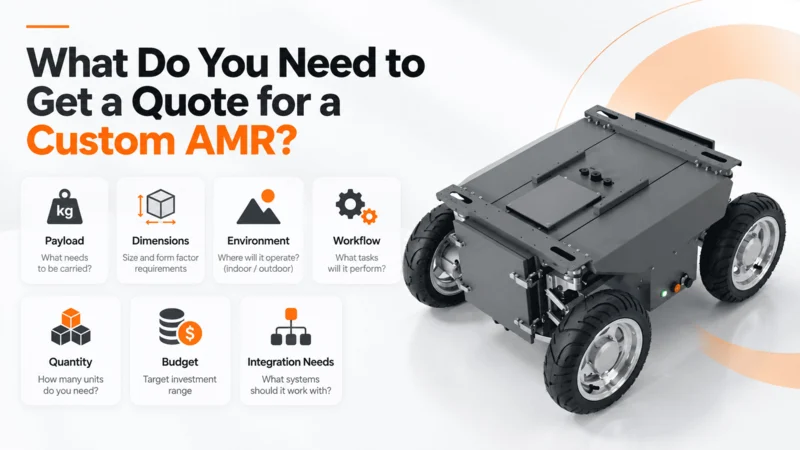
Want to ask a manufacturer about a custom AMR (autonomous mobile robot) but not sure where to start? The good news: you don’t need to understand navigation algorithms or battery capacity to request a preliminary quote. All you need to explain is what the robot should do, what it will carry, where it will work, and any special requirements. That’s enough for a manufacturer to start evaluating a solution.
This guide walks through the information to prepare, in the order you’ll actually need it. At the end you’ll find a ready-to-use RFQ checklist, a message template you can copy, and answers to common questions.
What Information Do You Need to Get a Custom AMR Quote?
For your first inquiry, you don’t need a finished technical specification. These six categories give a manufacturer enough to understand your needs and evaluate a suitable AMR solution.
| Information category | What to provide |
|---|---|
| Task | What work does the AMR need to do? Where does it pick up and where does it deliver? |
| Load | Maximum payload per trip, load dimensions (L × W × H), and how it is loaded and unloaded |
| Environment | Indoor or outdoor? Floor conditions, aisles, and the people or vehicles nearby |
| Daily workload | Distance per trip, trips per day, and working hours |
| Customization needs | Special dimensions, lifting, towing, or equipment and software integration |
| Purchase plan | Expected quantity, delivery location, and target delivery date |
These details don’t have to be exact at first. Rough figures such as “about 50 m one way” or “narrowest aisle about 1.5 m” are enough for a manufacturer to gauge your project. Anything you’re unsure about can be marked “TBC” and filled in later. In general, the clearer your information, the easier it is for the manufacturer to propose a realistic solution and quote. Let’s go through each category in turn.
1. What Task Should Your Custom AMR Perform?
Start by defining the job. An AMR can carry material bins, transport racks, tow carts, or carry inspection equipment on patrol. Each application places different demands on the robot’s structure and functions. Tell the manufacturer three things:
- Task: Will the robot carry bins, transport racks, tow material carts, or do something else?
- Route: Where does it pick up, and where does it deliver? Are there multiple stops along the way?
- Loading and unloading: At the destination, do workers unload by hand, or does the robot need to pick up, drop off, or connect with equipment automatically?
Example: “We need an AMR to carry material bins from the warehouse to the assembly line. The robot picks up at Point A, a worker unloads at Point B, and the robot returns to Point A to wait for the next task.”
You don’t need to choose a chassis type or navigation method in advance. Describe your actual workflow, and the manufacturer can tell you which AMR solution fits and whether any customization is needed.
2. How Heavy and How Large Is the Load Your AMR Needs to Carry?
For load-carrying AMRs, the weight, size, and handling method of your cargo are the main inputs a manufacturer uses to scope a custom solution. Be sure to give the maximum weight per trip, not the average.
- Maximum payload: What is the heaviest load per trip? If the goods sit in a bin, on a pallet, or on a rack, include the weight of those too.
- Load dimensions: Give the overall length, width, and height. If sizes vary, provide the largest. Also mention if the load is fragile, tip-prone, or has a high center of gravity.
- Loading method: Do workers place the load by hand, or does the robot need to lift racks, tow carts, or hand off to a conveyor automatically?
Example: “The maximum payload per trip is about 150 kg (including the rack). The load measures roughly 800 × 600 × 500 mm, and the robot needs to lift the rack automatically and deliver it to a designated position.”
This information helps the manufacturer determine the robot’s load capacity, platform size, and whether an extra handling mechanism is required. If you don’t have exact figures yet, give estimates or send photos of the load, and confirm the details once the solution takes shape.
3. What Environment Will Your AMR Work In?
The operating environment has a big influence on how a custom AMR is designed. A flat indoor warehouse and a workshop with ramps and door thresholds can place very different demands on the robot’s drivability and protection.
- Workplace: Will the AMR run in a factory, a warehouse, or outdoors? Is there dust, moisture, oil, or large temperature variation?
- Floors and aisles: Is the floor flat? Are there ramps, thresholds, narrow aisles, automatic doors, or elevators? Please include the width of the narrowest aisle.
- Surroundings: Will the robot share aisles with workers, forklifts, or other equipment? Is there frequent foot or vehicle traffic?
Example: “The AMR will run mainly in an indoor workshop with concrete floors. The narrowest aisle is about 1.5 m. The route passes through an automatic door, and some sections are shared with workers and forklifts.”
You don’t need professional CAD drawings. Start with site photos or a simple route sketch that marks the main aisles, obstacles, and loading points, so the manufacturer can picture your workspace. For complex sites, further measurements or an on-site survey may be needed later.
4. How Far and How Long Will Your AMR Run Each Day?
Travel distance and daily workload tell a manufacturer how much battery range, what charging approach, and how many robots your project needs. So when you request a quote, try to describe how many transport tasks the AMR must complete each day.
- Travel distance: Roughly how many meters is it from the pickup point to the drop-off point? Does the robot return to the start after each delivery?
- Daily workload: How many trips per day, and for how many hours? Does it need to run multiple shifts?
- Charging needs: Are there peak periods? Can the robot pause to charge, or would you like it to recharge automatically when idle?
Example: “Each one-way trip is about 60 m, with roughly 30 trips per day over an 8-hour shift. Tasks peak between 9:00 and 11:00, and we’d like the robot to return to charge automatically when it’s idle.”
You don’t need to calculate battery capacity or decide on travel speed. Just share the real transport distance, daily workload, and operating hours, and the manufacturer can estimate the right range, charging plan, and number of robots.
5. Which AMR Features Need Custom Development?
Customizing an AMR doesn’t always mean building one from scratch. Some projects only need a lifting mechanism, towing device, or dedicated cargo platform added to an existing robot platform. Others call for a resized chassis, special sensors, or integration with existing equipment and software. To help the manufacturer define the scope, split your requirements into two groups:
- Must-have features: What the robot absolutely needs to do the job, such as automatically lifting your existing racks, towing a specific cart, or receiving tasks from your production system.
- Nice-to-have features: Additions you’d like but don’t strictly need, such as automatic recharging, extra delivery stops, or interfaces reserved for future expansion.
Example: “We need an AMR that can automatically lift our existing racks and deliver them to specified production lines. We’d also like automatic recharging, and we may add more delivery stops in the future.”
If the AMR must connect to conveyors, automatic doors, or a warehouse management system (WMS), you don’t need to know the communication protocols in advance. Simply describe the outcome you want, for example: “When a production line needs material, the AMR should receive the task automatically and go pick it up.” The manufacturer will then confirm the right integration method. Separating must-haves from nice-to-haves helps the manufacturer scope the real customization work, give you a more suitable proposal and quote, and avoid unnecessary customization costs.
Not sure which features need custom development?
Send Fdata your existing equipment dimensions, must-have features, and site details. The team can discuss whether an existing robot platform can be adapted and which requirements need further confirmation.
6. What Purchasing and Delivery Information Should You Include?
Besides how you’ll use the robot, manufacturers usually need some project background to plan production, delivery, and support.
- Quantity: Are you buying one unit to test, or several at once? If you plan to run a pilot first and scale up later, describe the phases.
- Delivery timeline: When do you want to receive the equipment, and when do you want it in full operation? These may be two different dates.
- Delivery location: Which country or city will the equipment ship to? Shipping, installation, and certification requirements can vary by region.
- Target budget: If you have a rough range, share it. If not, you can still request a preliminary quote.
Example: “We plan to buy 2 AMRs for a trial run and order more if the results meet our requirements. Delivery is to Suzhou, Jiangsu, and we’d like the robots in use within about 4 months. Budget is not yet determined.”
Not sure how many robots you need? Share your expected transport volume and work rhythm, and ask the manufacturer to help estimate.
How to Prepare a Custom AMR RFQ (Request for Quotation)
Use the checklist below as your RFQ. The right-hand column shows sample entries only. Replace them with your own project details, and write “TBC” for anything you don’t know yet.
| Information needed | Sample entry (edit to match your project) |
|---|---|
| Main task | Move material bins from the warehouse to the assembly line |
| Maximum payload | 150 kg, including rack or container |
| Load dimensions | 800 × 600 × 500 mm (L × W × H) |
| Loading method | Robot lifts the rack automatically and sets it down at the station |
| Environment | Indoor concrete floor; some sections shared with people and forklifts |
| Route conditions | About 60 m one way; narrowest aisle about 1.8 m; no ramps |
| Daily workload | About 30 trips per day; 8 hours per day |
| Must-have custom features | Automatically lift specified racks and hand off at designated locations |
| Nice-to-have features | Automatic recharging; additional delivery stops later |
| Equipment / software integration | Receive tasks from the WMS; interface details TBC |
| Purchase and delivery | 2 units first; delivery to Suzhou; within about 4 months |
| Materials you can provide | Photos of the load, site photos, a simple route map |
Note: The dimensions, quantities, and timelines above are examples only and do not represent the performance of any specific model. For a preliminary quote, site photos and a simple route map are usually very helpful. For complex projects, a formal quote may require further confirmation of drawings and interfaces.
Copy-and-Paste RFQ Message Template
Fill in the brackets and send it straight to the manufacturer:
Hello! We plan to deploy a custom AMR at [location] for [main task]. The maximum payload is about [weight] kg, and the load measures [L × W × H]. The route runs about [distance] m one way from [start] to [end], with around [number] trips per day over [hours] hours. Site conditions: [floor, aisles, people and vehicles]. The AMR must [must-have features], and we’d like it to support [nice-to-have features]. We plan to purchase [quantity] unit(s), delivered to [city], with a target delivery of [date]. We can provide [photos / route map]; some parameters are still TBC. Please help evaluate a solution, provide a preliminary quote and lead time, and list the equipment and services included in the quote. Thank you!
If you only want a sense of the budget for now, add one more line: “We’d like to understand feasible options and a rough budget range first, and will request a formal quote once our requirements are confirmed.”
Inquiry details ready?
Send your completed checklist, load photos, or a simple route map to Fdata, along with your application, expected quantity, and target delivery date, so the team can start a preliminary requirements assessment.
What Happens After You Submit Your Inquiry, and How Do You Compare AMR Quotes?
Once you send your information, a manufacturer typically works through these steps:
- Review your task, payload, and site conditions.
- Ask follow-up questions on anything unclear, check your photos or route map, and, if needed, arrange a site survey.
- Propose a preliminary configuration, budget range, or quote.
For projects involving complex mechanical design or system integration, the technical and delivery scope may need to be defined before a formal quote is issued.
What to Check When Comparing Custom AMR Quotes
Don’t compare on total price alone. Check the items below to confirm that quotes from different manufacturers cover the same things.
| Quote item | What to confirm |
|---|---|
| Robot and custom mechanisms | Does the price include the robot itself, the lifting, towing, or cargo mechanism, and the related development costs? |
| Charging and accessories | Are batteries, charging stations, and necessary accessories included? |
| Software and equipment integration | Is fleet management (dispatch) software included? What about interface development and links to your existing equipment? |
| Shipping and on-site services | Are transport, installation and commissioning, route setup, and staff training included? |
| After-sales and commercial terms | Are warranty, technical support, taxes, payment terms, and quote validity clearly stated? |
Two quotes with similar totals can include very different equipment and services. Confirming what is included, what is charged separately, and what is still to be confirmed will help you decide better than comparing a single price figure.
Final Thoughts: Start Your Custom AMR Quote with What You Already Know
Getting a preliminary quote for a custom AMR doesn’t require you to be a robotics expert. Explaining your use case, load, site environment, daily workload, custom features, and purchase plan is already the most important step. Use the checklist above to organize what you know, mark the unknowns as “TBC,” and attach a few photos or a rough route sketch. Letting the manufacturer evaluate feasible options first, then refining the technical details and price range step by step, is the most efficient way to move forward. If you’d like to confirm your customization direction and budget range, you can contact Fdata for a custom AMR quote.
FAQ
What information do I need to provide to get a custom AMR quote?
You’ll usually need to provide six types of basic information: the robot’s task, the load’s weight and dimensions, the working environment, daily operating requirements, special custom features, and your purchase quantity and delivery plan. This helps the manufacturer evaluate a suitable AMR solution and give you a more targeted quote.
Can I request a custom AMR quote without CAD drawings or detailed technical specs?
Yes. A preliminary quote usually doesn’t require full CAD drawings or a technical specification sheet. You can start with a description of your application, the load dimensions, site photos, or a simple route map. For projects involving special structures or complex system integration, the manufacturer may ask for more detailed information before issuing a formal quote.
What if I don’t know which AMR customizations my project needs?
You don’t have to settle every technical configuration in advance. Just tell the manufacturer what you want the robot to accomplish, such as automatically lifting racks, towing carts, or working with production equipment. Based on your actual workflow, the manufacturer can help determine which functions can be achieved with an existing platform and which need dedicated development.
Can I request a quote if I’m not sure how many AMRs I need?
Yes. If you can’t determine the number of robots yet, share your daily trip count, distance per trip, working hours, and peak periods. The manufacturer can estimate your workload from that and suggest a suitable number of AMRs and configuration.
What’s the difference between a preliminary AMR quote and a formal quote?
A preliminary quote is based on your basic requirements and some estimated data. It’s mainly used to understand the proposed solution and a rough budget. A formal quote requires further confirmation of the technical configuration, customization scope, purchase quantity, and delivery content, so its pricing and inclusions are usually more precise.
